
What it means
Body fat percentage tells you what scale weight cannot — how much of your mass is fat versus muscle, bone and water. Tape-based methods estimate it to within about ±3–5 points, so read your result as a zone, not a score, and watch the trend over weeks.
How to measure body fat
You can't weigh fat directly, so every method estimates it — trading accuracy for access. From most reachable to most exact:
- Tape measure — costs nothing; this calculator turns a few circumferences into a percentage. The best all-round method at home.
- Skinfold calipers — more accurate if you own them and pinch the same spots each time, but easy to get wrong on your own.
- Smart-scale bioimpedance — one step on, but it drifts several points with hydration, food and skin temperature. Convenient, not precise.
- DEXA or hydrostatic weighing — the practical reference standard, accurate to about a point, but it needs a clinic and a fee.
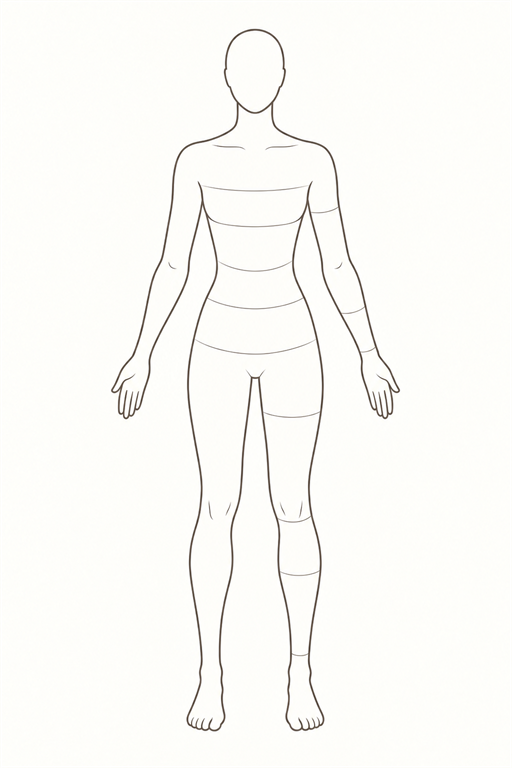
For the tape method here, measure on bare skin first thing in the morning, tape snug but not compressing, at the end of a relaxed breath out. Take each measurement twice and average the two. The calculator's where to measure guide marks exactly where each circumference goes — waist placement differs by sex (at the navel for men, the narrowest point for women). For a full walkthrough of tape placement, see how to measure your body.
With any tape method, consistency beats precision: same way, same time, same day of the week. You're tracking a trend, not chasing an exact figure.
The ACE fitness scale — a different lens
| Category | Women | Men |
|---|---|---|
| Essential fat | 10–13% | 2–5% |
| Athletes | 14–20% | 6–13% |
| Fitness | 21–24% | 14–17% |
| Acceptable | 25–31% | 18–24% |
| Above acceptable | 32%+ | 25%+ |
This is the American Council on Exercise's athletic classification — a training-oriented scale, not the same thing as a health range. The calculator itself judges your result against age- and sex-adjusted health ranges (Gallagher 2000), which is why its zones and this table won't line up: they measure different things.
Which method to trust
This calculator runs up to five tape/BMI methods and shows their range:
- US Navy (tape) — circumference-based; best all-round without equipment.
- RFM (tape) — waist and height only; validated against DXA, often the most accurate here.
- BMI-based (Deurenberg) — needs no tape; overestimates for muscular builds.
- CUN-BAE — BMI, age and sex; DXA-comparable, but shares BMI's muscle blind spot and is validated mainly in white adults.
- Covert Bailey (tape) — circumferences, age-adjusted.
Beyond this calculator: skinfold (Jackson–Pollock) is more accurate at home if you have calipers, and DEXA is the practical reference standard (home BIA scales drift with hydration).
For women
Healthy ranges sit 8–10 points above men's. Cycle water shifts move a tape estimate by a point — measure on the same week.
For weight loss
If weight drops but body fat holds, you're likely losing muscle — usually too aggressive a deficit or too little protein. Build the cut from your maintenance calories and keep protein high.
For athletes
Tape and BMI overestimate fat in muscular people. Use skinfolds or DEXA and treat the tape as a floor.
FAQ
How accurate is a body fat calculator?
Tape-based estimates land within 3–5 percentage points of a DEXA scan — enough to track direction over months, not to compare against someone else's number.
What is a healthy body fat percentage?
It depends on your age and sex, so there is no single number — the calculator applies age-adjusted health ranges (Gallagher 2000) for you. Across adulthood that is broadly 21–36% for women and 8–25% for men, drifting higher with age. The ACE table above is a separate fitness scale, not a health cut-off. Below about 13% (women) or 5% (men), essential functions are affected.
Why does my smart scale give a different number?
Bioimpedance scales read hydration as much as fat, so they swing several points within a day. Stick to one method.
How often should I measure?
Every two to four weeks. More often and you're reading noise.
Can I lower body fat without losing weight?
Yes — building muscle at steady weight lowers the percentage, common early in resistance training.
Does the calculator store my data?
The calculation runs in your browser, so nothing is sent to a server just to compute it. Save without an account and your history stays in this browser only. Sign in — an optional, passwordless email link — and your saved data syncs to your account so it follows you across devices, stored in the EU (Supabase, Frankfurt); you can export or delete all of it at any time.